
There are some places that simply become part of a neighbourhood. You pass them on the way to work, notice the tables filling up in the evening and, every now and then, catch the smell of something cooking and immediately wonder whether it's too early to start thinking about dinner.
Romanzo's Taverna is one of those places for us.
It sits just along Poole Road from No.82, and if you know Westbourne, there's a good chance you already know it. The little tables outside, the specials board by the door and that unmistakable smell from the charcoal grill drifting out onto the street.
This year Romanzo's is celebrating forty years in Westbourne, having first opened its doors in 1986. At the heart of it is Danny, owner and Head Chef, who still cooks over the charcoal grill himself and has spent years serving the kind of Greek food that really belongs around a table … generous, comforting and made for sharing.
So when we started planning our evening with Domes Resorts and Sovereign at No.82 on 30 September, having Romanzo's involved felt like a lovely way to bring a little bit of Westbourne into the evening too.
Danny is creating nine Greek canapés for us, which will be served throughout the night alongside chilled Prosecco, wine and beer. And somewhere between discussing what was going on the menu and deciding how hungry nine canapés were likely to make us, we started looking into where some of these familiar dishes actually came from.
We thought we knew Greek food rather well.
It turns out there was quite a lot we didn't know.
Because hidden behind some of the dishes we order without a second thought are stories that stretch back thousands of years, travelling through ancient Greece, Cyprus, Persia, Rome, Byzantine kitchens and the Ottoman Empire before eventually finding their way onto the tables we know today.
And at the end of this particular journey, onto ours at No.82.
—
It begins with the charcoal
If you've spent a summer evening in Greece, you'll probably know the smell before you know what's cooking. Charcoal, herbs and meat slowly grilling somewhere nearby … usually at exactly the moment you've decided you're not hungry yet.
Souvlaki feels so naturally Greek that we hadn't given much thought to just how old it might be.
At Akrotiri on Santorini, archaeologists discovered stone skewer rests dating from before 1600 BC that were used to cook small pieces of meat over an open flame. Thousands of years ago, people were essentially gathering around a grill and cooking meat on skewers in much the same way we still do today.
There's something rather lovely about that.
Even the name has been on a journey. Souvlaki comes from the medieval Greek souvla, meaning skewer, with roots stretching back to the Latin subula. It's a tiny reminder of how easily food travels between people and places, picking up little pieces of each along the way.
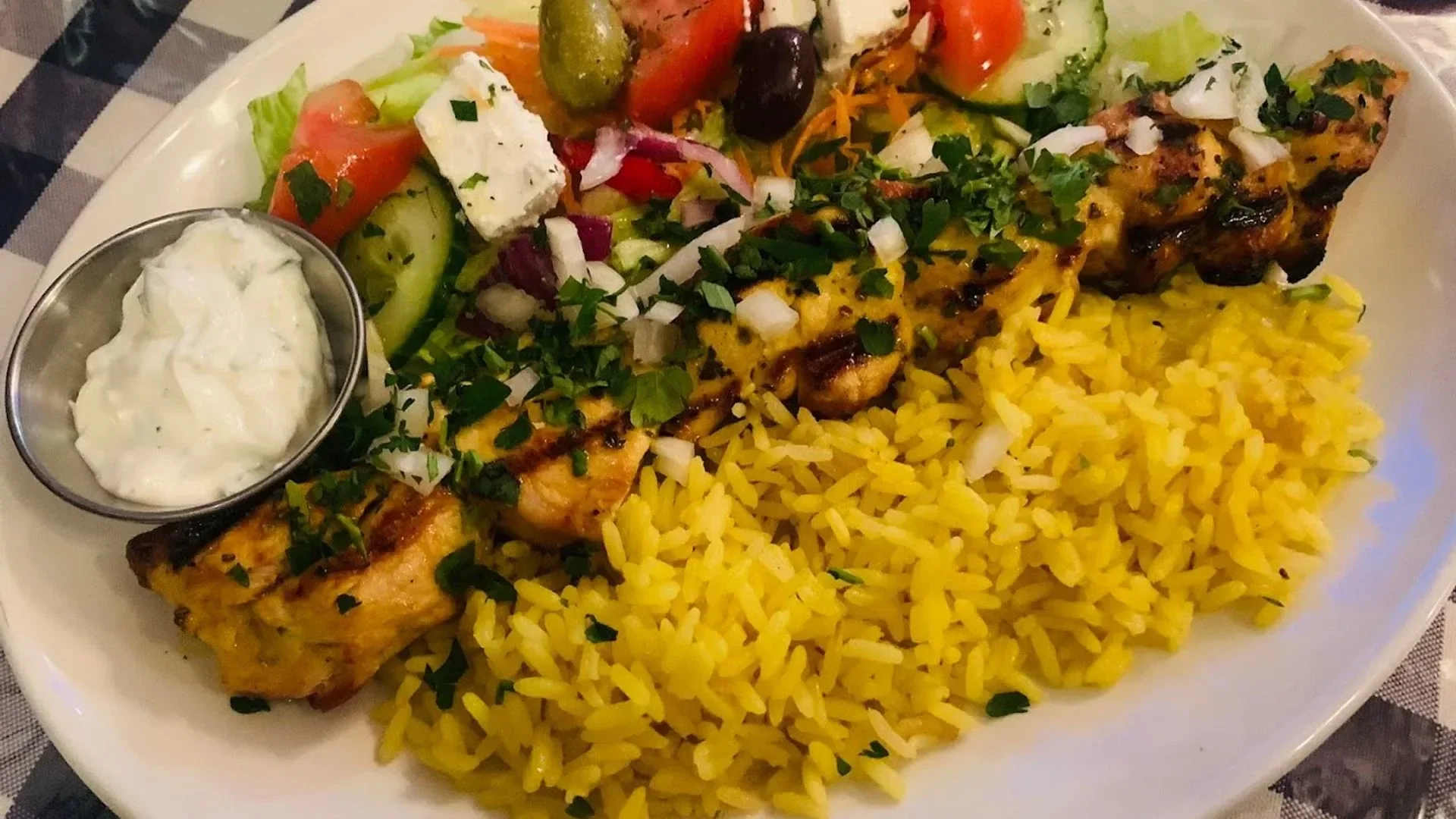
For our evening, Danny will be marinating chicken and lamb with mountain herbs before cooking them over the charcoal until they have those smoky, slightly charred edges that make you want to eat them straight from the grill. They'll be served with saffron rice and cool tzatziki, and we suspect they'll go particularly well with the first glass of wine of the evening.
Alongside them will be loukanika, a traditional Greek sausage whose name can be traced back to the Roman lucanica, associated with Lucania in southern Italy. References to it appear in Greek as far back as the fourth century AD, which is quite a history for something we'll happily be eating with a drink in hand on Poole Road.
At Romanzo's, it's smoked before being finished over the charcoal, giving it that lovely deep, savoury flavour that makes sharing slightly more difficult than intended.
'At Romanzo's, it's smoked before being finished over the charcoal, giving it that lovely deep, savoury flavour that makes sharing slightly more difficult than intended.'
—
A little something from the pan
Then there's saganaki.
The name actually comes from the sagani, the little shallow pan traditionally used to cook it, with links to the Turkish word sahan and the centuries in which Greek and Ottoman kitchens borrowed flavours and techniques from one another.
We also discovered that the theatrical flaming saganaki many people recognise today isn't an ancient Greek tradition at all. It's generally traced back to Chicago's Greektown in the late 1960s.
We rather like Danny's version.
Feta, tomato, olive oil and herbs are warmed together until everything becomes soft, rich and perfect for scooping up. It's simple Mediterranean cooking, and sometimes that's exactly what you want.
Halloumi, meanwhile, takes us to Cyprus. The cheese can be traced back to the Byzantine period, with written references appearing by the sixteenth century, and its relationship with the island remains so important that halloumi now has protected status in the EU.
For our evening it will be served warm with honey and sesame, so you get that lovely combination of salty golden cheese with a little sweetness from the honey.
We're already fairly certain we'll be hovering near that plate.
Keftedes will be making an appearance too. Their name came into Greek through the Ottoman world and has roots in the Persian kufta, meaning pounded meat. Different versions are found across the Mediterranean and Middle East, with recipes changing between countries, regions and, quite often, families.
Danny's are cooked until golden on the outside and soft inside, then served with tomato and onion chutney. They're exactly the sort of warm, comforting little mouthful that works beautifully when everyone is standing around talking, glasses are being topped up and another plate has just arrived from the kitchen.
Which is very much how we hope the evening will feel.
—
The ones wrapped in pastry
We've always had a soft spot for spanakopita, and its history is a wonderful example of just how far ingredients can travel before eventually finding one another.
Cheese pies appear in very early Greek writing, spinach made its way into the Mediterranean from Persia, and the delicate layers of phyllo pastry developed through Byzantine and Ottoman kitchens. Over time they came together to create the spinach, feta and pastry parcels we now know so well.
Ours will arrive warm, with crisp pastry wrapped around spinach, feta and dill. We'd recommend getting to these while they're still fresh from the kitchen, although we have a feeling they won't be sitting around for very long.
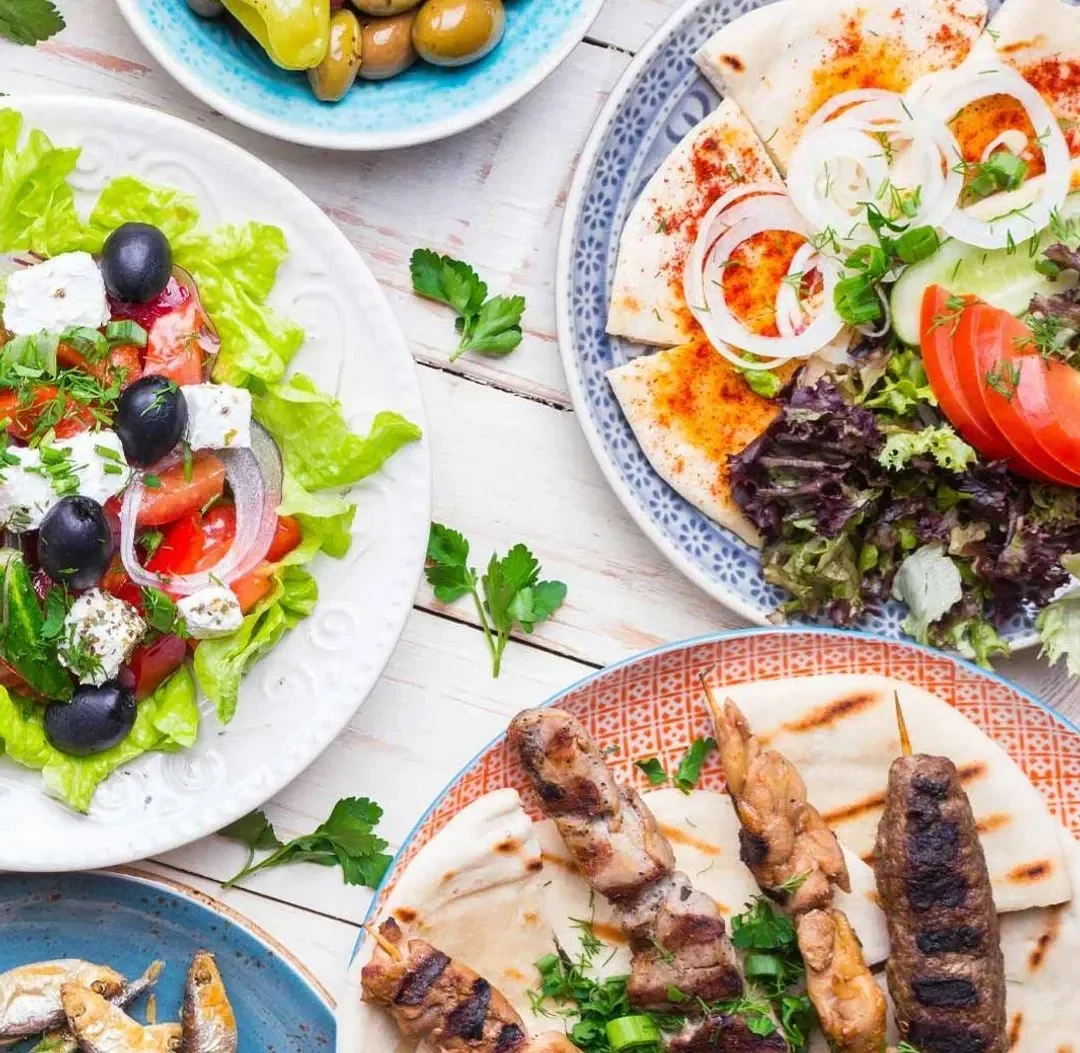
There will also be crisp pitta topped with houmous, feta and olives. Each of those flavours has sat happily on eastern Mediterranean tables for centuries in its own right, though this particular plate is simply how the kitchen has chosen to bring them together for the evening, rather than a dish with a history of its own.
And perhaps that's part of what we love about Greek food. It doesn't need to be overly complicated. Good ingredients, plenty on the table, something cold in your glass and people you enjoy spending an evening with.
That sounds rather nice to us.
—
And definitely save room for something sweet
We couldn't have an evening like this without baklava.
Or kataifi.
Preferably both.
There has been a centuries-long debate over exactly who invented baklava, and we have absolutely no intention of wading into it. Its modern form is often associated with the kitchens of Istanbul's Topkapi Palace around five hundred years ago, although similar layered pastries existed much earlier across the Middle East and Central Asia.
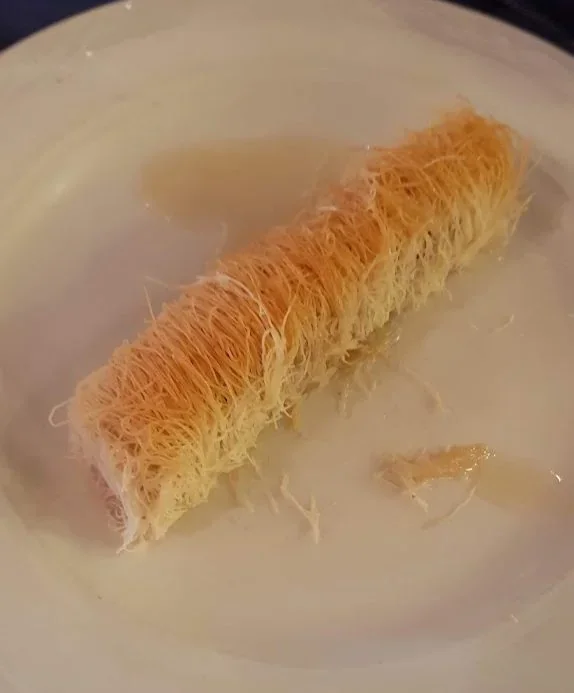
Kataifi has travelled an equally interesting route, appearing in different forms throughout the region with its distinctive fine strands of pastry wrapped around a sweet filling.
Both eventually arrive at the combination we care about most: crisp pastry, nuts, honey, cinnamon and syrup.
By this point in the evening, we think historical research can probably be put to one side in favour of trying both and deciding which one you'd go back for.
'By this point in the evening, we think historical research can probably be put to one side in favour of trying both and deciding which one you'd go back for.'
—
From somewhere far away, to somewhere very close to home
The more we discovered about Danny's menu, the more we loved the thought of all those journeys coming together for one evening in Westbourne.
Food carries so much with it. Recipes move between countries, ingredients find their way into new kitchens and families add their own little touches before passing them on again. Hundreds, sometimes thousands, of years later, we're still gathering around tables and enjoying versions of the same dishes.
Perhaps that's why Greek food lends itself so beautifully to an evening like this. It's generous and relaxed, the plates are there to be passed around, and nobody needs much encouragement to stay for another drink.
On 30 September, we'll be doing exactly that at No.82.
Romanzo's will be bringing the food from just along Poole Road, we'll have the Prosecco, wine and beer chilled, and Stew Plumridge from Domes Resorts and Kim Sellman from Sovereign will be joining us to bring a little more of Greece into the room.
If you've been to one of our evenings before, you'll know we like them to feel relaxed. Come in, find a comfortable spot, have something lovely to eat and a glass of something cold, and spend the evening talking travel with people who love it just as much as you do.
And if you haven't been to one yet, this feels like a particularly lovely one to start with.
Nine Greek canapés, a few glasses shared at No.82 and recipes that have taken several thousand years to get here.
We'll save you a seat.
Come find us at No.82.
hello@agentnouveau.com