
The Church You Can No Longer Drive To

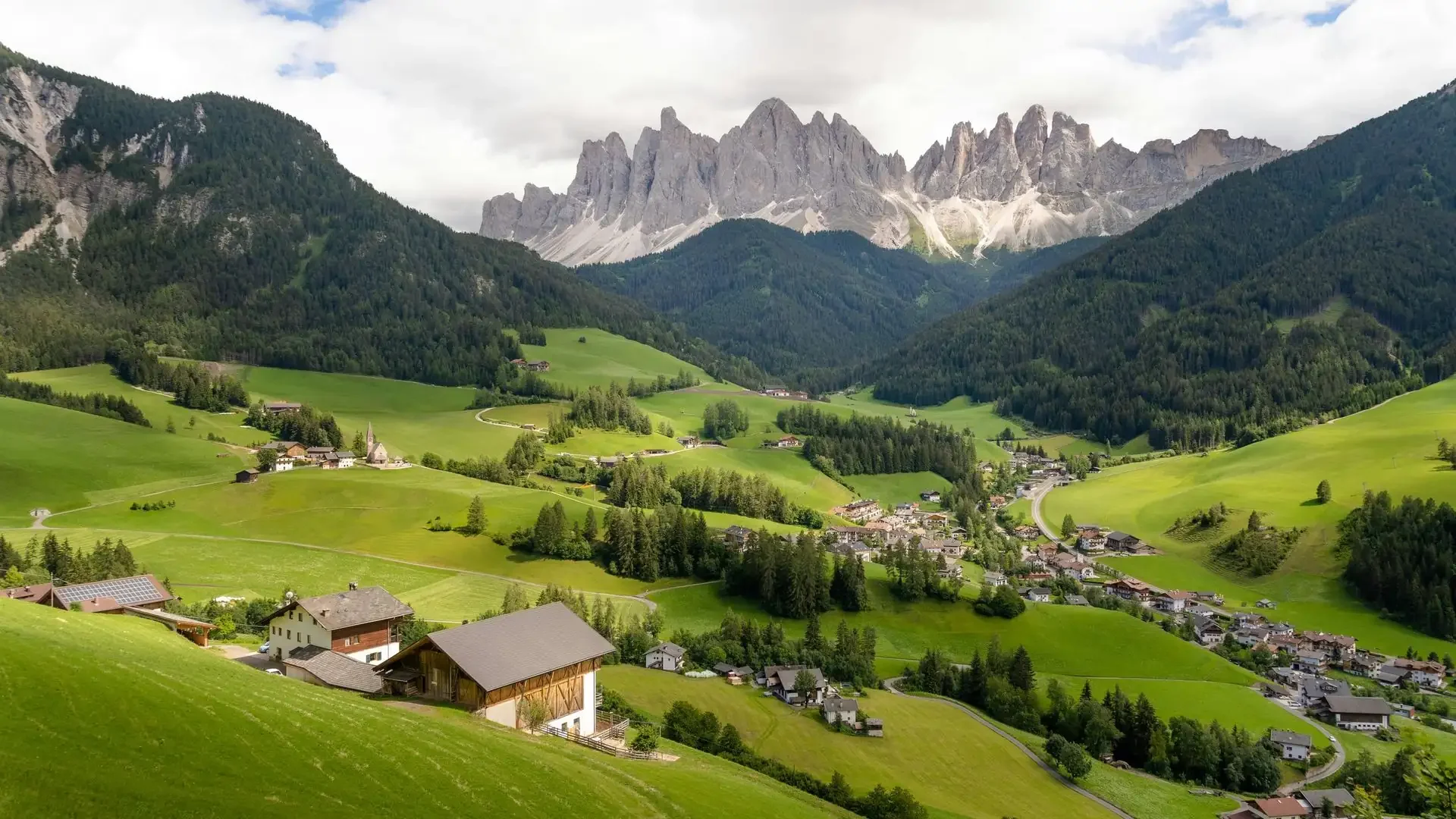
The road to Santa Maddalena, the small church framed by the Odle peaks in the most reproduced photograph of the Dolomites, closes to day-trip cars on 1 May 2026. The neighbouring meadow at San Giovanni in Ranui, the other much-photographed church in the valley, has been closed to the public entirely; access is now reserved for guests of the owners' hotel.
Both decisions sit inside the same valley — Val di Funes, in the autonomous province of South Tyrol — and both responded to the same problem. Up to 600 visitors per day, almost all of them arriving for the same photograph, almost all of them leaving within an hour.
— What has been decided —
The Funes municipality, led by Mayor Peter Pernthaler, will move an existing barrier into the centre of Santa Maddalena village from 1 May 2026 through November. Local residents and visitors staying in the area at least one night will continue to drive to the church. Day-trip cars and tour buses will be turned away. Designated parking sits roughly thirty minutes' walk from the church viewpoint, and parking fees will rise — currently four euros for a full day — to discourage drivers arriving solely to take a single photograph.
San Giovanni in Ranui has gone further. The meadow that gave the church its photograph, formerly accessible via a paid turnstile, has been closed to the general public from 2026. Access is now reserved for guests staying at the owners' hotel. The viewpoint is gone unless you are sleeping in the building that owns the field.
The provincial government did not impose either decision. Both came from the people who live there.
'The trajectory from obscure South Tyrol valley to regulated by ordinance took roughly fifteen years and one mass-circulating image set'
— Why this is more interesting than it looks —
A small parish in the Italian Alps regulating access to a church is not, on the face of it, a sector story. It is a parish council story.
Place it next to the others, though, and it reads differently. Hallstatt installed wooden barriers to block the view from its most photographed lakefront. Dubrovnik capped cruise arrivals. Venice introduced a day-tripper fee. Amsterdam ran the "stay away" campaign. Kyoto closed sections of the Gion district to camera-carrying day-trippers. Each on its own is a discrete policy. Together they are a category emerging — destinations regulating attention, with photograph-driven traffic as the trigger and slow-tourism rhetoric as the framing.
What the Val di Funes restrictions add is the regulatory move arriving in a place that is not a city, not a UNESCO front door, not a name most travellers would have heard before social media made it one.
The trajectory from "obscure South Tyrol valley" to "regulated by ordinance" took roughly fifteen years and one mass-circulating image set.
— What changes for the agent and the client —
The luxury client is largely insulated from the visible parts of overtourism. They are not in the queue at the Trevi Fountain. The client booking Val di Funes for summer 2027 is more likely to be staying at Hotel Tyrol Dolomites or one of the small farmhouse hotels in Santa Maddalena than driving up for a quick stop. They are, by definition, the residents-and-overnight-guests category that the new barriers explicitly admit.
The change still matters for them, in two ways. First, it changes what a "view" costs in time and planning — a stay that includes the morning walk to the Santa Maddalena viewpoint at 7am, before the parking fills, will simply be a different proposition than the one available in 2024. Second, the same logic is going to keep arriving in other valleys. Seceda already had a private turnstile installed by a meadow owner in 2025. The pattern travels. Knowing that the destination has the conversation built in is part of what serious planning now looks like.
'A destination quietly choosing what kind of tourism it wants'
— The quieter trend underneath —
The Val di Funes story has been framed by international press as overtourism friction. It is also a destination quietly choosing what kind of tourism it wants. Mayor Pernthaler has said the goal is to encourage longer stays and to deter visitors who arrive solely to leave with a photograph.
That language is being used by more municipalities every year. The traveller who books a week in the valley, walks the Adolf Munkel Trail, eats lunch in an alpine pasture hut, and learns the rhythm of the place is the traveller these places are quietly building for. The good operators have been building for them all along.